
How Does FlexWerk Pricing Compare to a Studio Lease?
FlexWerk and a studio lease are different financial species: FlexWerk charges per booked hour with the room, equipment, and utilities already included, while a lease is a fixed monthly obligation you owe whether you deliver five sessions or fifty, before you’ve bought a single dumbbell. The exact hourly rates live on the pricing page and in the get-started conversation; what this article can do is show you how to compare the structures honestly.
The structural difference: variable versus fixed
Everything downstream flows from one distinction. With hourly rental, space cost is variable, it exists only when revenue does. Every booked hour is attached to a paying session, so a slow month is a cheap month and a packed month funds itself. With a lease, space cost is fixed, the rent is identical in your best month and your worst, and it started the day you signed, months before your calendar filled.
Fixed costs aren’t evil; they’re leverage. Leverage amplifies full calendars and punishes empty ones. The question is whether your business today is the kind that should be leveraged.
Time is part of the same distinction. A lease binds you for its term, commonly measured in years, while hourly booking binds you for sixty minutes at a stretch. That asymmetry matters most when your future is uncertain in ordinary ways: a client base still growing, a family situation in motion, a business model you’re still refining. Optionality has a value spreadsheets tend to price at zero right up until you need it.
What a studio lease really costs
The advertised rent is the beginning of a lease, not the total. A realistic accounting commonly includes:
- Base rent on a multi-year term, often with annual escalations.
- CAM charges, utilities, and property insurance layered on top of base rent in many commercial leases.
- Buildout, flooring, mirrors, lighting, sound, paint, turning an empty box into a training space.
- Equipment, racks, cables, dumbbells, cardio, commonly a five-figure outlay before opening day.
- A personal guarantee, which many landlords require from a first-time studio owner, putting your personal finances behind the term.
Add the quiet costs: the months of rent paid during buildout and ramp-up, and the exit cost if life changes mid-term. The full picture is closer to the cost of opening a small gym than to a rent check, which is exactly why so few solo trainers ever make the leap.
What’s inside a FlexWerk hour
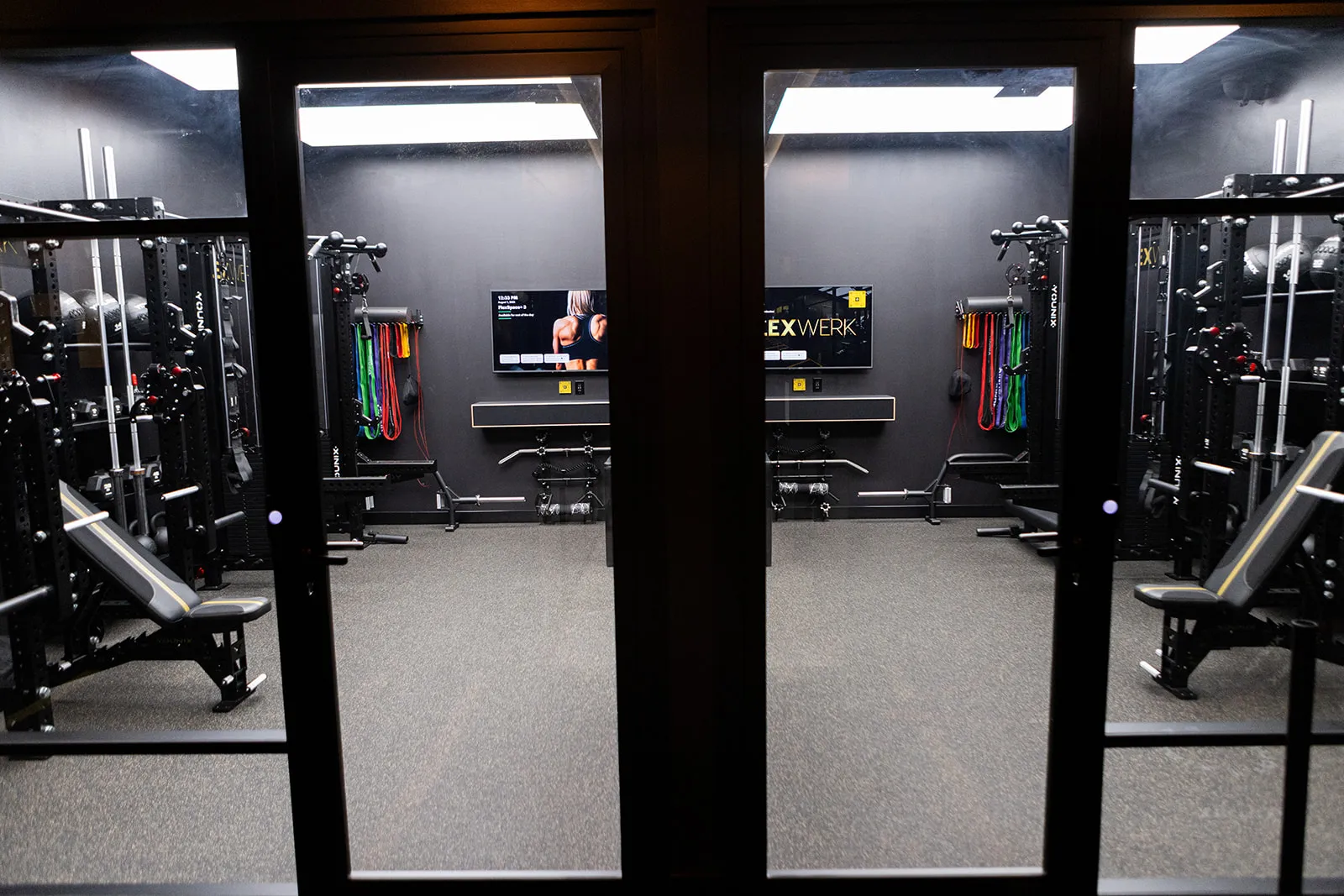
The hourly booking at FlexWerk Carmel is the finished product rather than the raw material. Each private suite comes equipped, FlexSpace Standard supports 850+ exercises with a custom lifting rack, cable system, and dumbbells; FlexSpace Plus expands to 1,100+ exercises with room for up to four guests; cardio suites run HYDROW rowers, CLMBR machines, and curved treadmills. WiFi, music streaming, a TV/monitor, and controllable lighting are standard, and the suites are deliberately built to be filmable.
Structurally, there’s no lease, no membership, and no commitment, you book by the hour through the app, during hours that run 5 AM-9 PM weekdays and 7 AM-4 PM weekends, and you keep 100% of what you charge your clients. The comparison to a lease isn’t just rent versus rate; it’s rent plus buildout plus equipment plus term risk versus a per-hour price with all of that already inside it.
When a lease still wins, honestly
The hourly model is not the answer to everything, and pretending otherwise would be salesmanship. A lease deserves serious consideration when:
- You’re running very high, very consistent volume, especially multiple trainers under one brand, where a fixed cost spread across many weekly sessions can beat per-hour pricing at the crossover point.
- Your model needs an open floor, large group classes and team training don’t fit a private-suite format.
- Total brand control is the product, your signage, your buildout, your address as the destination.
- You need heavy custom or permanent equipment that no shared facility would house.
If two or three of those describe you, model the lease seriously. If none do, and for most solo and semi-private trainers, none do, you’d be paying a fixed cost for optionality you don’t use.
Running the comparison for your own book
Four steps, one evening:
- Project your realistic weekly sessions for the next six months, not the dream calendar, the probable one.
- Get the real hourly numbers from the pricing page and the get-started conversation, and multiply by those sessions.
- Price the lease scenario fully, rent, extras, buildout and equipment amortized over the term, plus the ramp months.
- Compare totals, then compare risk. The hourly total scales down automatically if your projection was optimistic. The lease total doesn’t.
And revisit the comparison yearly rather than treating it as settled. The right answer at twelve sessions a week may not be the right answer at thirty, some trainers eventually outgrow hourly space into their own facility, and that’s a success story, not a contradiction. The point of starting variable is that you get to make the fixed-cost decision after the demand exists, with your own booking history as the evidence.
For most independent trainers, the hourly column wins on cost until the calendar is very full and wins on risk at every stage. The no-commitment structure is the part spreadsheets undersell: you can test the entire model with one client and one booked hour, and the first one is free at /get-started/.
Related questions
Where do I find FlexWerk's actual hourly rates?
Start at the pricing page and the get-started funnel, rates are part of a short conversation rather than a one-size-fits-all sticker, and your first hour is free to try before any of it matters.
Does FlexWerk require a lease or minimum commitment?
No. Suites rent by the hour through the FlexWerk app with no lease, no membership, and no long-term commitment, you book when you have a session and stop whenever you like.
What's included in a suite that a lease wouldn't cover?
The buildout and equipment: custom lifting rack, cable system, dumbbells, connected cardio in cardio suites, plus WiFi, music streaming, a TV/monitor, and controllable lighting, all present the day you book.