
Can I Rent Gym Space With No Long-Term Commitment?
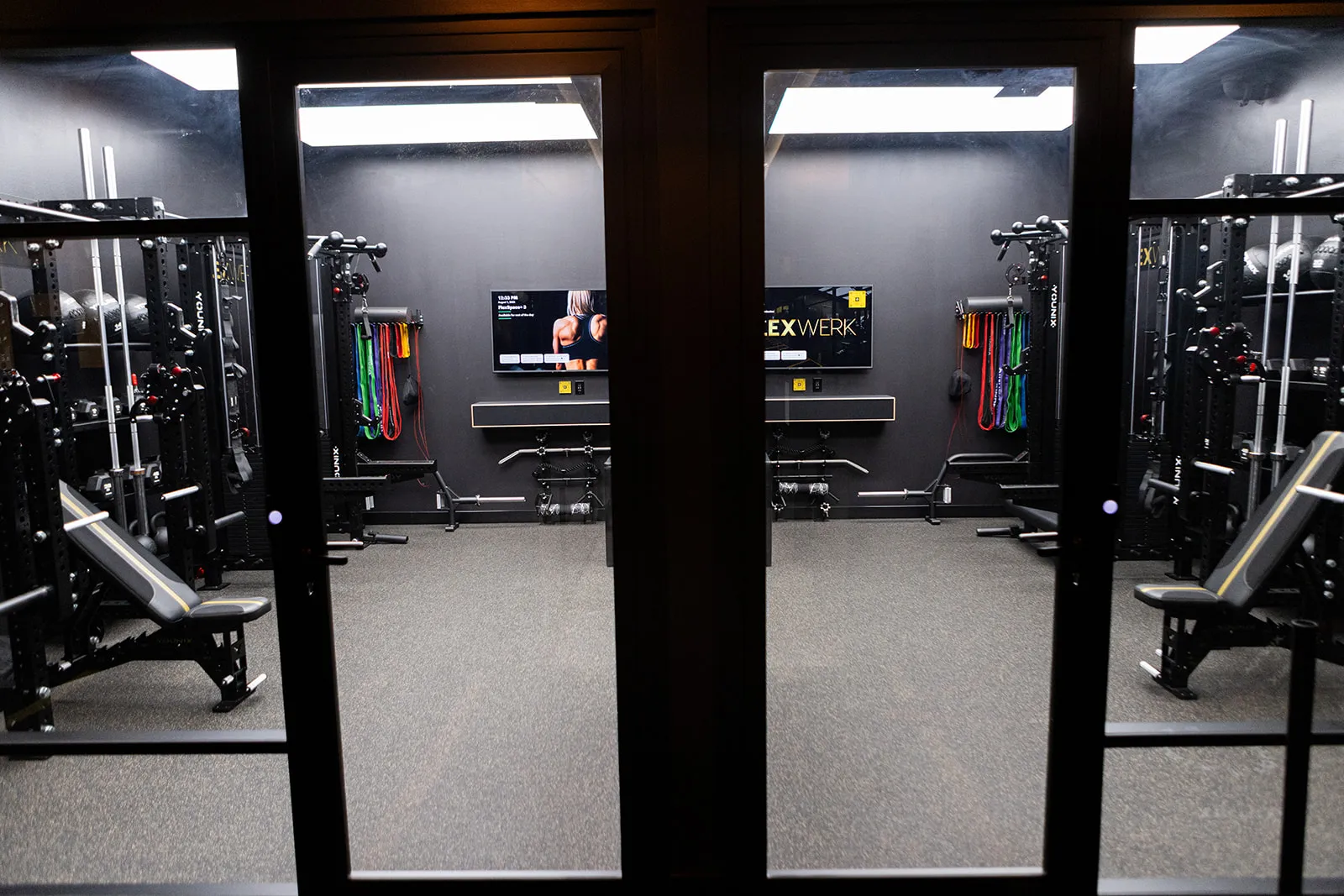
Yes, you can rent professional gym space with no long-term commitment at all. At FlexWerk in Carmel, private fully equipped suites book by the hour through an app, with no lease, no membership, and no contract term: the booked hour is the entire obligation. For trainers burned by lease horror stories or gym-floor politics, this isn’t a loophole or a promo, it’s the facility’s whole design.
What “no commitment” means here, precisely
The phrase gets abused in fitness marketing (ask anyone who’s tried to cancel a “no-commitment” gym membership), so it’s worth being literal about what the hourly model removes:
- No lease. You never sign for space by the year, or the month.
- No membership. There’s no recurring fee that exists independent of your bookings.
- No revenue split. What you charge clients is yours; the facility isn’t a partner in your rate.
- No exit process. Stop booking and the relationship simply pauses, nothing to cancel, no notice period, no penalty.
What remains is a pure transaction: an hour of private, equipped space in exchange for that hour’s fee. Book one hour in March and none in April, and April costs zero. Nothing accrues, nothing renews, nothing needs cancelling, your calendar is the only contract in the relationship. The mechanics of the booking flow itself are covered in how hourly gym rental works.
Why most training space still demands commitment
Commitment isn’t an accident in this industry, it’s how the traditional economics function. A studio landlord wants a multi-year lease because a tenant’s promise is the collateral for the building. A gym wants trainers on membership-plus-commission because splits, commonly 40 to 60% of every session at big-box facilities, are the business model. A sublease host wants a flat monthly fee because your fixed payment de-risks their slow months.
Notice the pattern: in each structure, someone else’s risk becomes your obligation. The commitment isn’t there for your benefit; you are the stability someone else is buying. The hourly model breaks the pattern by charging for usage instead of promises, which is why it took a purpose-built facility, rather than a lease workaround, to offer it properly.
What commitment-free actually gets you
The obvious benefit is flexibility; the underrated one is what it does to a growing practice:
- Slow months stop being scary. Vacation, seasonality, an injury, a client’s relocation, with no fixed rent, a light month is a light expense instead of a personal debt.
- You can scale up in hours, not in leaps. Adding a fourth weekly client means booking four more monthly hours, not wondering whether your book justifies a studio.
- Experiments get cheap. Test a Saturday-morning block, a semi-private format in a Plus suite, a second early-morning wave, each experiment costs its own hours and nothing more.
- Leverage stays with you. Every month, the space earns your continued booking on merit. Facilities structured this way have to stay good, and the roughly 24 sessions a week the average FlexWerk pro runs suggests the model holds up under real workloads.
And “commitment-free” doesn’t mean “bare-bones”: the booked hour includes a genuinely private suite with a full strength build or connected cardio, WiFi, streaming, and free guest access for your client, the suite details show what each room holds.
As for who this fits: commitment-free space maps naturally onto certain career moments. The trainer leaving a big-box job with fifteen clients and no appetite for a lease. The mobile trainer consolidating a scattered book without betting savings on a studio. The part-time coach with a day job whose eight weekly sessions could never justify fixed rent. The specialist, a therapist seeing cash-pay patients, a prenatal trainer, a senior-fitness coach, whose clients value privacy but whose volume varies by season. In every case, the shared feature is uncertainty about future volume, and the hourly structure prices uncertainty at zero.
It fits established heavyweights differently but still usefully: even a full-book trainer benefits from a cost structure that flexes when life does, and from never having a landlord conversation again.
The honest fine print
No structure wins everywhere, and pretending otherwise would undercut the point. Two real trade-offs:
- At very high volume, flat rent can be cheaper per session. A trainer running a packed, stable schedule may find a lease or sublease pencils out lower per hour, accepting, in exchange, the fixed obligation and its slow-month risk. Run the actual comparison in FlexWerk vs. the cost of a studio lease.
- Popular hours reward planning. Commitment-free doesn’t mean demand-free; the 6 AM and after-work slots are the ones every trainer’s clients want, so booking ahead is the professional habit.
Neither caveat is hidden in the model, they’re the visible price of flexibility, and most trainers weigh them in minutes. If neither changes your answer, the hourly structure is almost certainly yours; if one does, at least the comparison was honest and you’ll sign your lease knowing exactly what it buys.
Proving it to yourself costs nothing
A claim like “no commitment” deserves a test with no commitment: FlexWerk’s first hour is free for fitness professionals. Book a suite, bring a client, run the session, and notice, on the way out, that nobody asks you to sign anything. Start with the free hour, and let your calendar decide what happens after.
Related questions
Do I need a membership to book a suite at FlexWerk?
No. There's no membership, no lease, and no long-term commitment, you book hours through the FlexWerk app as you need them, and that's the entire relationship.
When does a lease actually make more sense than hourly rental?
At very high, very stable session volume, or when your method needs space and equipment a suite can't hold, flat rent can beat per-hour costs. The trade is that the rent is owed in your slowest month too.
Can I try commitment-free space before building my schedule around it?
Yes, FlexWerk gives fitness professionals their first hour free, so you can run a real client session before a single dollar is involved.