
How Does Hourly Gym Space Rental Work?
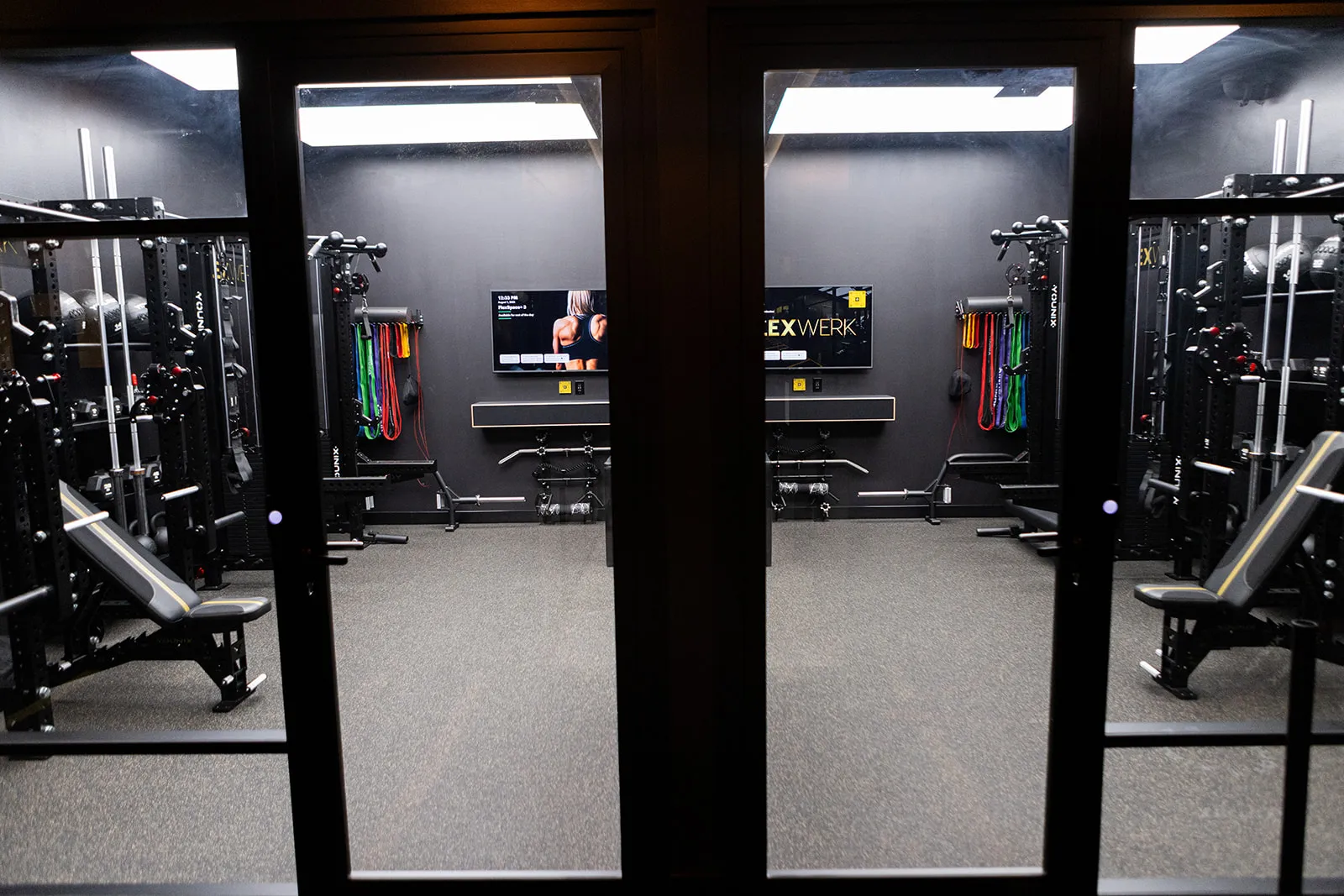
Hourly gym space rental works like booking a meeting room: you reserve a private, fully equipped training suite through an app for the hours you need, pay only for those hours, and walk in ready to coach, no lease, no membership, no revenue split. Your client joins you as your guest, you charge them your rate, and you keep it all. The model exists so a trainer’s space cost can track sessions actually run instead of arriving as fixed rent.
The booking flow, step by step
At a dedicated facility like FlexWerk in Carmel, the cycle from “client confirmed” to “session done” looks like this:
- Open the app. Suites and time slots show in real time, the FlexWerk app is the front door for everything.
- Pick the suite for the job. A Standard suite for one-on-one work (rack, cable system, dumbbells, 850+ exercises), a Plus for semi-private groups of up to four, or a cardio suite with HYDROW rowers, CLMBR, and curved treadmills.
- Book the hour, or the block. Consecutive hours stack for back-to-back clients.
- Meet your client and train. They come in on free guest access; the room, music, lighting, and screen are yours for the booked time.
- Get paid your way. The facility isn’t between you and your client’s money. Whatever you charge, 100% stays with you.
That’s the entire administrative footprint. No lease negotiation, no security deposit on a storefront, no monthly invoice, the mechanics of a specific booking are detailed in how to book a FlexSpace.
What you’re paying for, and what you’re not
An hourly fee bundles what a studio owner assembles piecemeal: commercial space, professional strength and cardio equipment, WiFi, music streaming, a TV/monitor, controllable lighting, and, critically, privacy, since a suite is a room with a door rather than a lane on a shared floor.
Just as important is the list of things the model deletes from your cost structure:
- No rent in slow weeks. Vacation, a light January, an injury, unbooked weeks cost nothing.
- No commission. Big-box arrangements commonly take 40 to 60% of each session; here the house takes a booking fee for the hour and nothing from your rate.
- No capital. The rack, cables, and cardio are someone else’s balance-sheet problem.
What stays on your side of the table: your liability insurance, your programming, and your client relationships, the actual business.
How trainers structure a week around it
In practice, working professionals treat hourly space like calendar Tetris played in their favor. Client sessions cluster into blocks, a 6 to 9 AM run of back-to-back hours, an evening block after office hours, so booked time stays dense and cost-efficient. Facility hours are built for that rhythm: FlexWerk runs 5 AM-9 PM on weekdays and 7 AM-4 PM on weekends, covering the early-bird and after-work slots where client demand actually lives.
It scales to a full-time practice: more than 40 fitness professionals run their businesses on this model at FlexWerk Carmel, averaging around 24 sessions per week each. The rhythm most settle into is simple, recurring weekly slots for standing clients, booked ahead, with one-off hours added as new sessions land.
The model also flexes across professional types, which is part of why it took hold. A personal trainer books strength suites for client blocks. A physical therapist sees cash-pay patients in complete privacy. An online coach books an hour to film, the suites are deliberately filming-friendly, and a semi-private trainer books a Plus suite and serves several clients inside a single booked hour. Same mechanics, different businesses.
One practical note wherever you rent hourly: confirm the professional basics before your first booked session. Carry your own liability insurance, understand the facility’s guest arrangements, and know the operating hours you’re planning around. None of it is complicated, but sorting it before a client is standing next to you is the professional move.
What it costs, and the honest trade-offs
Rates vary by market and facility, so the useful move is to get current numbers directly, FlexWerk’s pricing page explains the structure, and the team will talk specifics. For context on the decision itself: the hourly model’s advantage is risk, not always raw per-session cost. At very high volume, a flat-rent arrangement can work out cheaper per session, the trade being that the flat rent is owed in your worst month too. Most independents below that volume threshold come out ahead on hourly, and everyone comes out ahead on downside protection.
Two more small trade-offs, stated plainly: you plan around bookings rather than wandering into “your” space at will, and popular hours reward booking ahead like anything else with real demand. When you compare options, compare honestly, a full week’s hourly total against a full month’s fixed costs, using your real average session count rather than your best week’s. The structure that survives your slowest realistic month is usually the right one.
The zero-cost way to see it work
The model’s best feature is how cheaply it can be tested. FlexWerk gives fitness professionals their first hour free, book a suite, bring an actual client, run an actual session, and judge the mechanics with your own calendar on the line. Claim the free hour here, and the next question, which suite, which time blocks, which rate you’ll charge in a room this good, answers itself faster than any article can.
Related questions
Do I pay anything in weeks when I don't book?
No. The hourly model has no membership, no lease, and no monthly fee at FlexWerk, cost exists only when a booked hour does.
What does hourly gym rental cost?
It varies by market and facility. FlexWerk walks trainers through current rates directly, start on the pricing page or with the free first hour and have the conversation with real numbers.
Do my clients pay the facility anything?
At FlexWerk, no, clients of trainers receive free guest access. Whatever you charge for the session is between you and them, and you keep all of it.