
How Much Space Does a Reformer Need for Private Sessions?
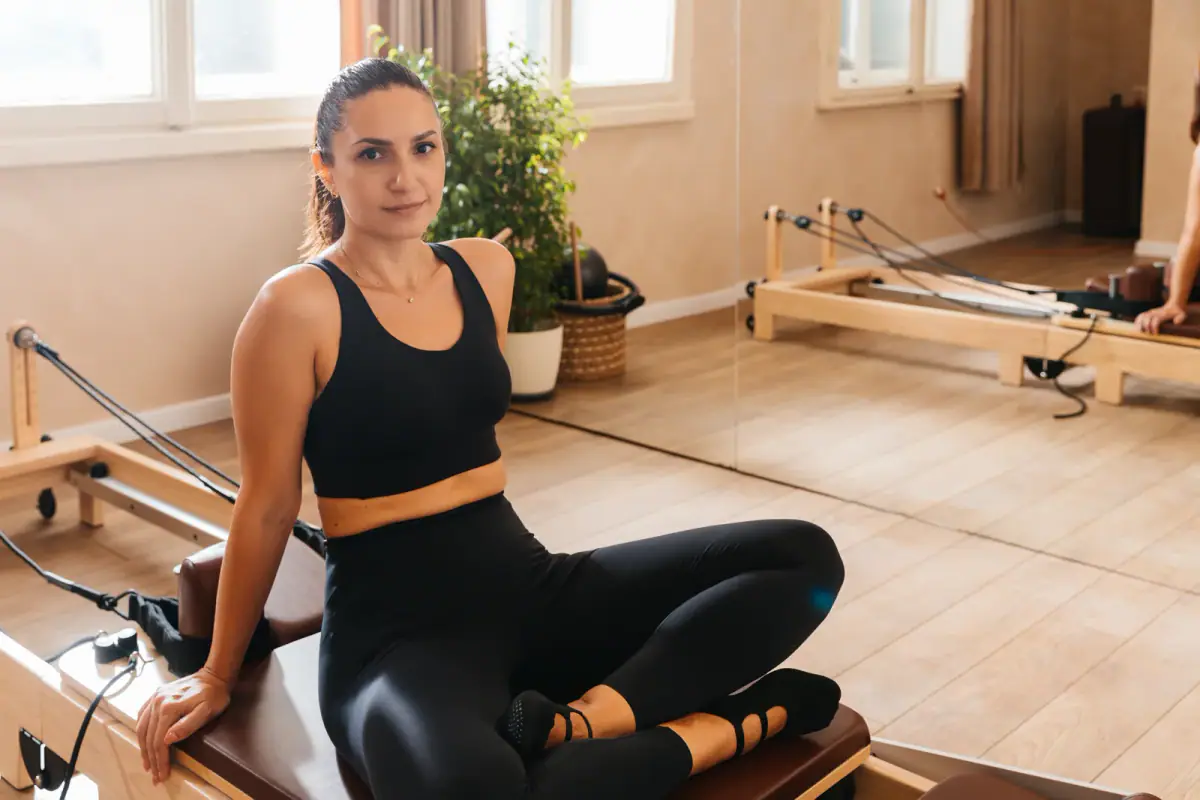
One reformer, a walkway for the instructor and one client fit inside 150 square feet only if the room is shaped to give the machine a clear, straight line, so the usable answer comes from the room’s dimensions and the machine’s extended length, not from area alone. The room math below uses round numbers as a worked example. Replace them with your specification sheet and the room’s real measurements, which the team can share when you ask about the space.
Start with the machine at its working length
Reformers vary, so use your own specification sheet. As a rough guide, many are on the order of eight feet long and a couple of feet wide, and some extend further when the footboard or ropes are positioned for tall clients. Treat those numbers as a placeholder, not a fact about your machine.
Measure three things:
- Parked footprint: length and width as it sits.
- Working footprint: length with the footboard in its farthest position and any rope or pole extended.
- Height: matters for low ceilings and for any wall-mounted fixtures.
Add standing room: at the head end for a client to sit up, at the foot end for them to step on and off, and along one side for you to move. Around two to three feet on the instructor’s side and on each end is a typical planning figure, but your own movement style decides it.
The floor-plan sum
To keep the example simple, imagine a rectangular room of 150 square feet that measures ten feet by fifteen feet. Real rooms differ, so this is only a worked illustration.
| Item | Space it takes along the long wall |
|---|---|
| Machine at working length | about 8 to 9 feet |
| Clearance at both ends | about 4 to 6 feet |
| Total along the 15 foot wall | about 12 to 15 feet |
That uses nearly all of one dimension. Across the ten foot width, the machine takes roughly two to three feet, leaving seven feet or so for your walkway and a client waiting area. On paper it fits, with little to spare.
Now change one input. If your machine extends to ten feet, or the room is nine feet wide, or a door swings into the line, the sum fails. This is why “how many square feet” is the wrong question and “what is the straight clear length” is the right one.
What a second person changes
Count every body that needs floor at once:
- The client on the machine. Included above.
- The instructor. Needs the walkway along one side and access to springs.
- A second client waiting or doing floor work. Needs about the footprint of a person lying down, plus space to avoid the machine’s moving carriage.
- A duet on two machines. Needs a second machine’s length and width, which a 150 sq ft room is unlikely to hold.
If your plan involves two clients at once, a larger room or a mix of apparatus and floor work for the second client is more realistic. The way two clients share an hour is covered in how to run duet sessions.
Matching your numbers to the room you would rent
At Carmel City Center, a Standard FlexSpace is 150 square feet and a Plus FlexSpace is 200 square feet. The rooms are built around a lifting rack, a cable system and dumbbells, which also take floor and wall space, so the clear floor is less than the total area. The equipment in each room page lists what is there, and there is no reformer on site.
Ask the pro support team at prosupport@flexwerkfitness.com for:
- Wall-to-wall dimensions of the room you would book.
- The position of fixed equipment and doors.
- Whether instructor-owned apparatus is allowed, a policy question covered in bringing a reformer to a rented studio.
If the numbers say no
If the sum fails, you have options that need less floor: mat sessions, small apparatus that stores in a bag, or a larger room. Instructors in nearby suburbs face the same question, as discussed in pilates studio rental near Fishers. A room that cannot hold your machine can still hold a good session if you plan the kit around it.
Bring a tape measure to your free first hour as a fitness professional, measure the real room and redo this table with your own figures before you commit to anything heavy.
Related questions
Can two clients share one reformer room?
Only with one machine, and only one client uses it at a time. A duet on separate apparatus needs a second machine and roughly double the footprint, which a small room will not hold.
Is square footage enough to judge fit?
No. A long, narrow machine needs a long, clear line, so the shape of the room matters as much as its area. Ask for real wall-to-wall dimensions and any obstructions.
Should I measure with the springs and footboard extended?
Yes. Measure the machine at its longest working position, not its parked size, and add the standing room you need at each end.