
Cable Machine or Free Weights in a Rented Room?
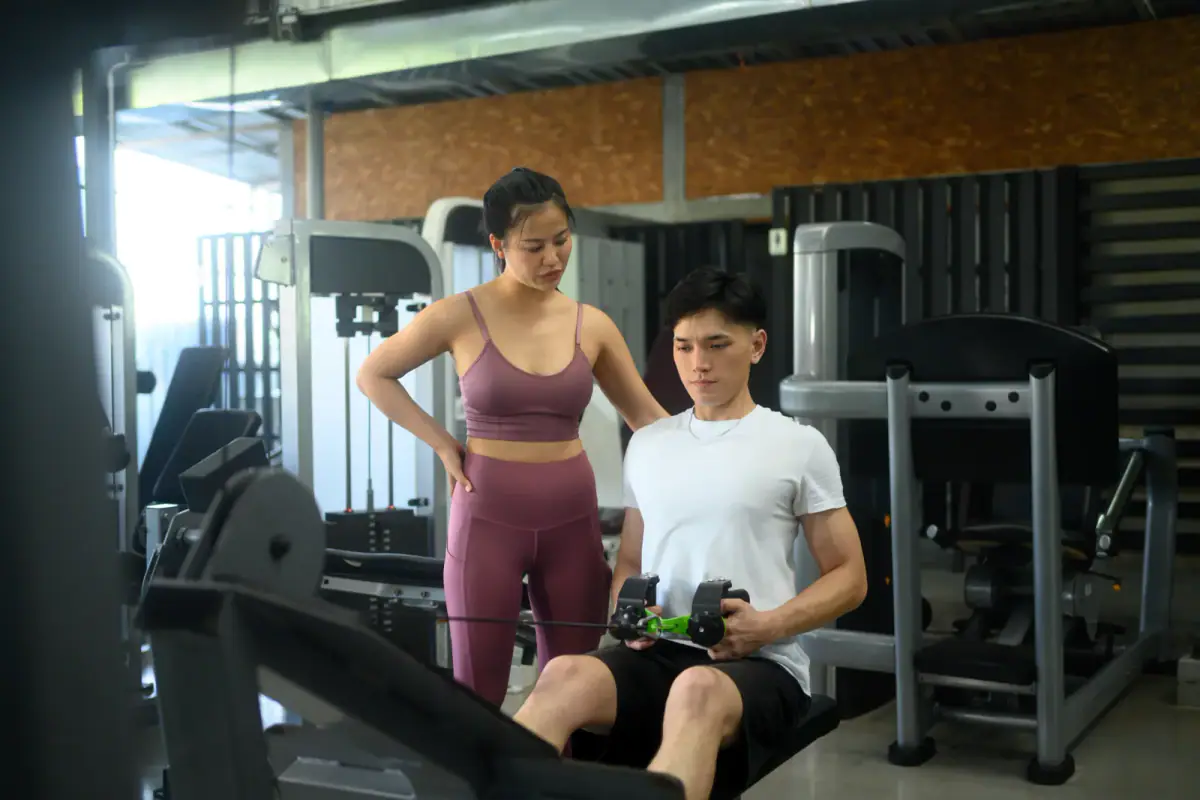
In a rented room, a cable station gives you more exercise variety per square foot, while free weights give you easier heavy loading, so most coaches get the best results when the room holds both. If you must choose one, pick by client type: cables for mixed beginner, older and rehab-adjacent clients, loose weights for strong lifters. The rest of this page is the trade-off, so you can judge a room before you claim a free first hour.
What a cable station buys you
A single adjustable cable tower can serve as a row, a press, a pulldown, a rotation trainer and a leg exercise station. Two practical benefits matter in a one-on-one room:
- Smooth, even resistance. Tension stays constant through the movement, which feels forgiving to a nervous beginner and gentle on cranky joints.
- Fast changes. Moving a pulley takes seconds, so you can change an exercise without loading and unloading plates, and your client does not cool down.
- Safer failure. Letting go of a handle is easier to survive than dropping a loaded bar.
The costs are a fixed footprint, a swing zone around the station, and a ceiling on how heavy the stack goes for strong lifters.
What free weights buy you
Dumbbells and a rack handle heavy compound lifts, unilateral work and carries. Weights are portable within the room, so you can reposition them for a circuit or a semi-private session. They are also the better tool for teaching balance and bracing, because the client has to control the path.
The trade-offs: a rack of dumbbells takes wall space, heavier sets need more floor clearance, and a bar loaded for a squat needs a rack and a clear landing area. Our guide to the equipment list for a strength training room walks through what a full setup needs.
A comparison you can use
| Question | Cable station | Free weights |
|---|---|---|
| Footprint | Fixed, with a swing zone | Flexible, but needs storage |
| Variety per square foot | High | Moderate |
| Heavy loading | Limited by the stack | Strong |
| Beginner comfort | High | Moderate |
| Older or rehab-adjacent clients | Often a good fit | Fine with light loads |
| Setup time between exercises | Quick | Slower with plates |
Match the choice to your clients
Run through these if-then rules:
- If most of your clients are 55 and older, lean on cables and light dumbbells. The planning notes in equipment for senior fitness sessions show why.
- If you coach athletes or strong lifters, insist on a rack and a serious dumbbell range.
- If you run semi-private sessions, cables can bottleneck, so favor loose weights.
- If you film content, cables look clean on camera and keep the floor free.
Where FlexWerk fits
Each FlexSpace is fully equipped with a custom lifting rack, a cable system and dumbbells, so you rarely have to choose between them; the details sit in what equipment is in a FlexSpace. A Standard space is 150 square feet and supports 850 or more exercises, and a Plus space is 200 square feet with 1,100 or more. Spaces rent by the hour through the app, with no lease or membership.
The choice still matters when you evaluate other rentals, or when you plan what to bring. Make a list of your five most-used exercises, check the room against it, and book a test hour to see how the equipment feels with a real client.
Related questions
If I can only have one, which should I pick for general clients?
Most coaches who work with a mix of beginners and intermediates pick the cable station, because it covers pulling, pressing, rotation and single-limb work with one setup. Free weights win when your clients are strong and your programming is barbell-heavy.
Do cables work for strength athletes?
As accessory tools, yes. For heavy squats, deadlifts and presses, cables are a supplement to loose weights, not a substitute.
Does a fixed station make a small room feel smaller?
It can. A cable tower has a fixed footprint and a swing zone for the handle, so check the clearance on a floor plan before you plan a full-body session around it.