
Square Feet per Person for a Small Group Class
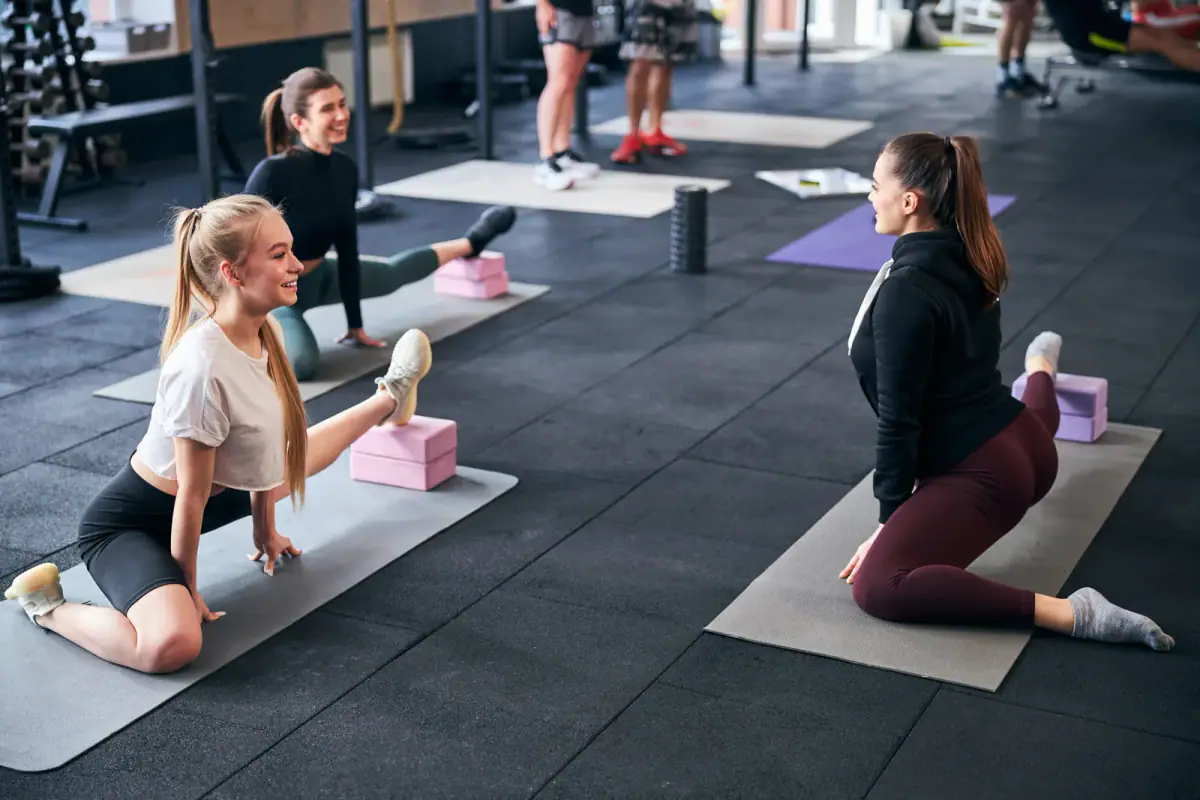
For a small group class, plan the floor space each person needs by the movement they do: lifting at a station needs the least, and traveling or floor work needs the most, with the room’s stated guest limit as the ceiling. FlexWerk’s Standard is 150 square feet for 1 to 2 guests and its Plus is 200 square feet for up to 4 guests. To see how a roster actually fits, book a first hour and run your class with the full group.
Start with the room
| Room | Size | Stated guests | Floor per guest at the limit |
|---|---|---|---|
| FlexSpace Standard | 150 sq ft | 1 to 2 | 75 sq ft |
| FlexSpace Plus | 200 sq ft | Up to 4 | 50 sq ft |
The last column is simple division of the room by the guest limit, and it includes space taken by equipment, so usable floor per person is less. That is why the right roster often sits below the maximum.
Allowances by movement
These are working allowances, and your own test matters more than any table.
- Station lifting with one rack and cables: the least space per person, since each person works in a defined spot.
- Circuit rotations: add room for walking between stations, which reduces how many fit.
- Floor work, mobility and stretching: each person needs the length of a body plus arm reach in every direction, so count a full lane.
- Traveling movements and jumps: allow a clear runway and landing area per person, which cuts capacity the most.
- Cardio machines: capacity is the number of machines, not the floor.
Because every setup differs, treat these as questions: where does each person stand, and where do they go next?
A practical roster test
- Place the equipment as you will for the class.
- Mark each person’s spot with tape or a note, only if the facility allows it, or use your own sketch.
- Run the first and last ten minutes of the class at full speed.
- Watch for collisions, waiting, people shortening their range of motion and awkward handoffs.
- Reduce the roster by one if you see any of those.
If the class works at full speed with everyone in, you have your number. Write it into your class description.
Check the numbers that are not about comfort
The guest limit comes first, as explained in how many people can train in a small private room. Your insurance and waivers also need to cover every participant, and each person should have signed before arriving. For how rentals handle a class format, see small group class space rental.
When the answer is a different room
If your class keeps hitting the edge, book the larger room or split into two sessions rather than squeezing in another person. A related method for one-on-one sizing is in square feet for a personal training room, and equipment-specific needs appear in how much space a reformer needs.
Turning space into a price
Floor space is part of your cost per head. Divide the hourly room cost by the number of people you can comfortably coach, then add your own time and margin. A smaller group at a higher price per person often leaves you better off than a full room at a discount, since the experience is part of what you are selling.
A smaller roster at a higher price per head usually beats a crowded room and a distracted class.
Related questions
Is there an official square footage per person?
Building and fire codes set occupancy limits, and those apply to the facility. For coaching quality, the useful number is the space each person needs to move safely, which you set from your own session.
How do I test the number for my class?
Run the full class with a friendly group in the actual room. Watch for collisions, waiting and people altering their movements to avoid each other, then cut the roster by one if you see them.
How big are the FlexSpace rooms?
A Standard is 150 square feet for 1 to 2 guests, and a Plus is 200 square feet for up to 4 guests. Use those as the starting point for your roster.