
In-Home Personal Training Equipment Kit: What Fits in a Trunk
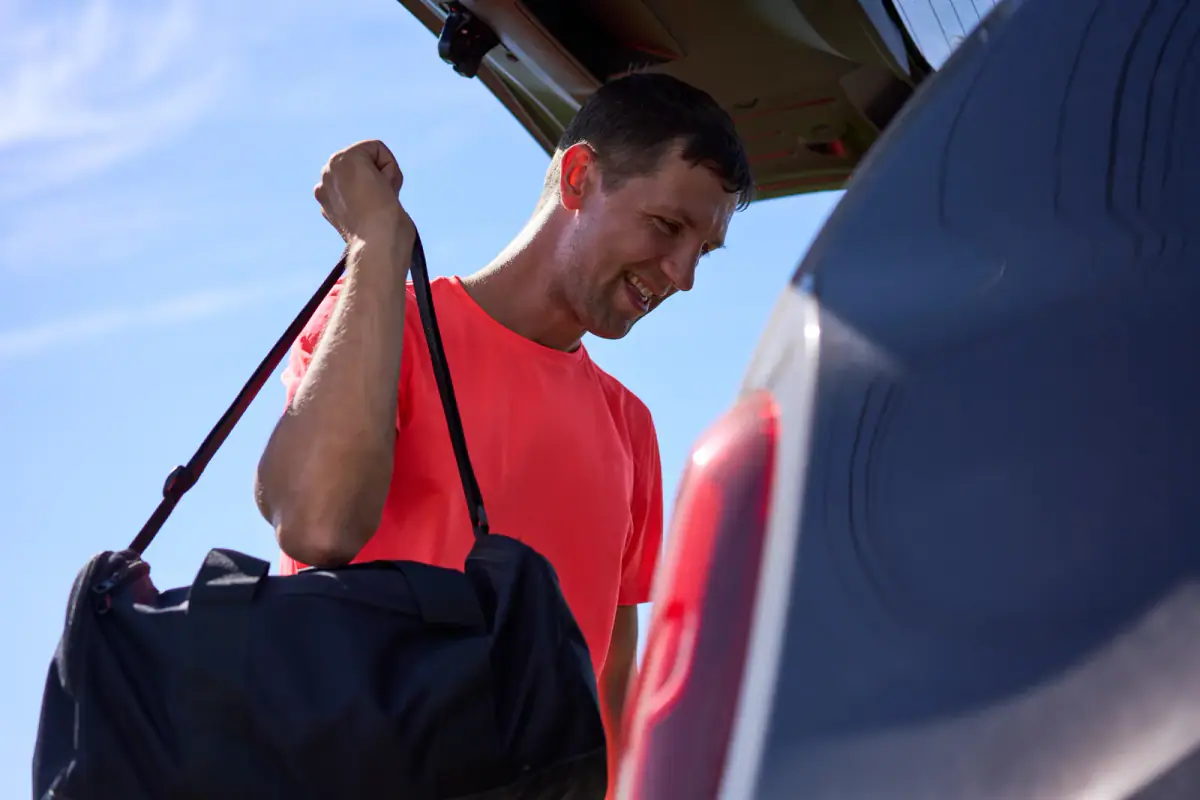
A good in-home kit is one trunk’s worth of gear: a set of loop and tube bands, one compact adjustable bell, suspension straps, a thin mat, and a handful of small tools. That list can cover squat, hinge, push, pull and carry patterns for a general-population client. Anything heavier than that is a reason to move the session, which you can do through an hourly room with the first hour free.
Pack by movement pattern, not by gadget
Trunk space is a budget, and the way to spend it is to make sure every basic pattern has two loading options.
- Squat and lunge: one adjustable bell held at the chest, plus a long loop band under the feet for tension at the top.
- Hinge: the same bell, plus a band anchored low behind the client for a pull-through.
- Push: suspension straps for angled press-ups, a mini band for a harder variation.
- Pull: the straps again, anchored to a door or sturdy post, which is why they are the highest value item in the bag.
- Carry and core: the bell for suitcase carries, a light ankle band for lateral steps and dead bug variations.
If a pattern has only one way to be loaded, a client who plateaus has nowhere to go. Two options per pattern, in a bag you can carry up a flight of stairs, is the standard to pack against.
The kit, with what each piece replaces
| Item | What it covers | Skip it if |
|---|---|---|
| Long loop bands, light to heavy | Assisted pull-ups, banded squats, resisted walks | Your clients already own bands |
| Mini bands | Glute and shoulder activation | You rarely coach lower body warmups |
| Compact adjustable bell | Goblet squats, rows, carries, presses | You only work with very light loads |
| Suspension straps | Rows, presses, assisted single leg work | The home has no safe anchor point |
| Thin folding mat | Floor work, protecting hard floors | The client has a workout area already |
| Small tools: timer, tape, marker | Rest control, tracking tempo | You program entirely on a tablet |
Treat the table as a starting point. A trainer who coaches older adults may swap the straps for a stability pole and a firm chair, while one who coaches runners may add a foam roller before a second weight.
How to stage a session so the trunk stays small
Pack the kit in the order you will use it, with the warmup tools on top. Many trainers keep the bag permanently packed so that the only decision before leaving is which bell load to set. Rehearse the setup time too: if unpacking takes ten minutes of a sixty minute session, the client is paying for logistics rather than coaching. A reasonable target is two minutes to lay out the mat and attach the straps, then straight to work.
Charge for the load you carry. Travel time, wear on the vehicle and the gear itself belong in your rate, and how to charge for in-home personal training walks through building that number. The small kit pairs naturally with the planning in training clients in a home garage, where you may add a few more items because the garage becomes a semi-permanent site.
When the trunk is the wrong tool
Some programs outgrow a bag. Barbell squats and presses, cable work, heavy pulls, rowing and treadmill conditioning all need equipment that you cannot reasonably haul. At that point you have three honest choices: ask the client to buy equipment for their home, tell the client the program is limited, or book a room that already has it.
At FlexWerk in Carmel, a private space comes with a custom lifting rack, a cable system and dumbbells supporting 850+ exercises in a Standard room, and the client enters as your free guest. Trainers who sell in-home sessions can mix the two: light days at the client’s house, heavy days in a booked hour. That split is explained further in comparing a mobile practice to a rented room, and bringing your own gear into a rented room shows how the same bag then shrinks to personal tools.
Your next step is to pack the kit once, run a full week out of it, and note which pattern kept forcing you to improvise.
Related questions
Should I carry a full set of dumbbells to client homes?
Rarely. A single adjustable bell covers most loading needs, and a pair of heavy dumbbells turns every session into a freight job. If a program truly needs a rack and a full dumbbell run, that is a signal the session belongs in a room that already has them.
Do clients' homes need to supply anything?
Ask for a clear floor area, a sturdy chair, and a door or beam you may anchor to. Everything else should come from your bag, because a kit that depends on whatever the client owns makes every session a different workout.
How do I keep a trunk kit from damaging a client's floors?
Carry a thin protective mat you can lay under loaded work, use rubber-coated implements, and set weights down rather than drop them. Floor damage is the fastest way to lose an in-home client and the only item in the kit that protects the client's property rather than the workout.