
Private Training Studio Rental Near Indianapolis: What You Actually Get
Search “private training studio rental” around Indianapolis and you are actually looking at three different products: leasing a studio of your own, subletting hours inside somebody else’s, or booking a purpose-built private room by the hour. They share a keyword and almost nothing else. The equipment, the privacy, the costs, and the risks differ so much that choosing between them is really choosing a business model.
Here is what each version hands you, what each one costs on the north side, and how to match them to where your business actually is.
The three products hiding behind one search term
Your own leased studio gives you total control: your keys, your paint, your rules. It also gives you a multi-year commitment, an equipment bill, and every operational headache from HVAC to insurance. It is a real estate project wearing a fitness costume, and around the metro these commitments typically run multiple years with personal guarantees attached.
A sublease inside an existing studio rents you hours or a corner from an owner who got there first. Entry is cheaper, but the calendar priority belongs to the owner’s programs, the branding on the wall is theirs, and your rent arrives monthly whether your clients do or not.
A purpose-built hourly room flips the structure: a facility designs private studios specifically to rent to professionals one session at a time. Near Indianapolis, the clearest example sits in Carmel, where FlexWerk rents private FlexSpaces at Carmel City Center with nothing signed beyond the booking itself.
What the hourly version actually includes
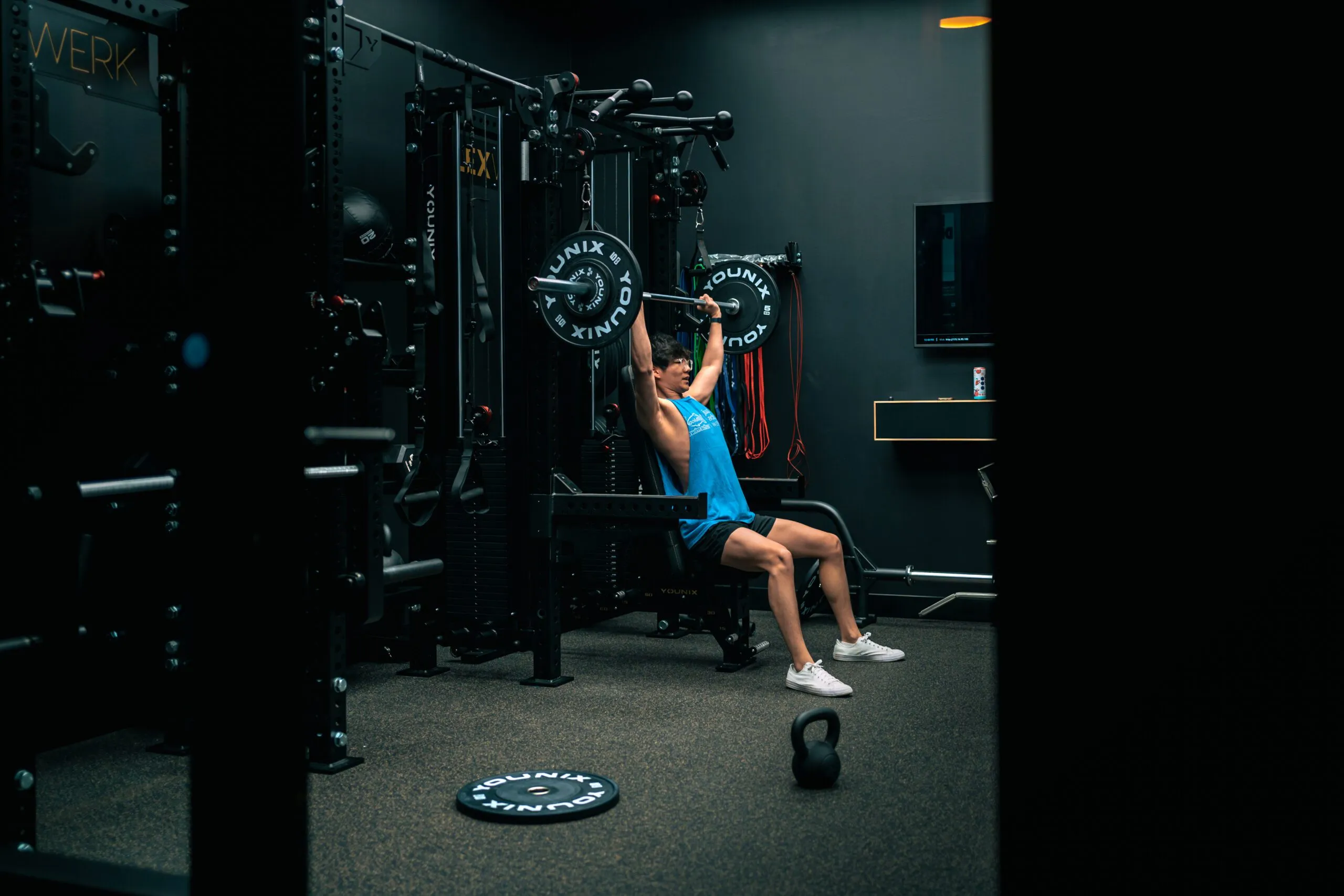
The test of any private studio is whether the room works the moment you walk in. A FlexSpace does: rack, cables, and dumbbells ready for programming (850+ exercises in a Standard room, 1,100+ in a Plus), cardio rooms holding HYDROW rowers, CLMBR climbers, and curved treadmills, plus WiFi, a screen, streaming audio, and lighting that answers to you. The rooms were deliberately designed to film well, which matters if content is part of your marketing. Everything books in the FlexWerk app against real-time availability, so the same studio scales from one session a week to a full practice without a single conversation with a landlord.
The privacy is the part clients pay for without naming it. A door that closes changes who shows up and who stays: true beginners who dread commercial floors, professionals who want discretion, people rebuilding after years away. Your programming is the same in any building; their experience is not. Clients also enter free as your guests, so nobody needs a membership to train with you.
What each option costs near Indianapolis
A leased studio means rent plus utilities, insurance, equipment, and fit-out, a five-to-six-figure commitment before your first billable session. Subleases in the metro vary widely but share one property: the invoice ignores your booking count. The hourly model prices per session instead, and FlexWerk’s rates are flat and published: $18 to $22 per hour for training rooms, cardio spaces from $12, with the first hour free for fitness pros. The pricing page carries the current numbers, and there is no split on top; the session fee you charge is yours in full.
Because private-setting trainers around Hamilton County commonly command $75 to $125 or more per hour, the per-session margin math favors the hourly room early and often. Test it against your own roster with the what would you keep calculator, which compares your current arrangement to a booked-by-the-hour week in about a minute.
Five questions that expose a weak listing
The gap between a good listing and a good studio shows up the moment you start asking:
- Who else can be in the room? “Private” sometimes means a partitioned corner of a shared floor. Insist on a door that closes and sole use of everything behind it.
- What does the hour include? Ask whether equipment, screens, music, and guest entry carry separate charges. In a FlexSpace, the booking covers the room and everything in it.
- How does booking happen? Live in-app availability means you can grab Tuesday at 6 AM right now; an email thread means you probably cannot.
- Do the hours fit training demand? Client demand piles up before work and after it. FlexWerk opens weekdays at 5 AM and runs to 9 PM; weekends go 7 AM to 4 PM. That is the shape a coaching calendar needs.
- What do clients deal with outside the room? Parking, entry, and the walk to the door are part of your product. At Carmel City Center, the parking garage is a short walk from the door, steps off the Monon Trail.
Matching the model to your stage of business
Just going independent? Book hourly by default; taking on fixed rent before revenue exists is the most common first-year wound, and it is now entirely optional. The going independent guide covers the sequencing.
Established with a variable book? Hourly still wins, because growth and shrinkage are both just calendar changes. Summer travel gaps, the January intake wave, and a client moving away stop being financial events when space is billed per session. More than 40 fitness professionals run their practices out of the Carmel rooms on exactly this logic.
Running near capacity, building a team, want your name on the door? Now a lease is a legitimate conversation, entered from strength, with proven volume, rather than from hope.
One habit serves every stage: never commit to any space, theirs or ours, without coaching a real session in it first. How the room feels mid-session tells you more than any listing photo ever will.
The free first hour exists for precisely that experiment; set up your Fit Pro account, bring a client, and let the room argue for itself.
Related questions
What size is a private training suite?
FlexWerk's Standard rooms run 150 sq ft for one or two guests and the Plus rooms run 200 sq ft for up to four, and purpose-built layouts train larger than the numbers read. Elsewhere, always ask whether the quoted square footage is the room itself or a share of an open floor.
Can two trainers see the same client roster in one suite?
Each booking belongs to one professional, so partners typically alternate reservations or book adjacent hours. A host can walk you through how small teams usually structure shared rosters across rooms.
Is a private studio worth it for semi-private sessions?
Usually more than for one-on-ones, because a 200 sq ft room serving up to four guests spreads one hourly cost across several paying clients while keeping the session completely private. Delivering that credibly on a shared floor is much harder.