
Jiu Jitsu Private Lessons Without a Gym: What to Plan
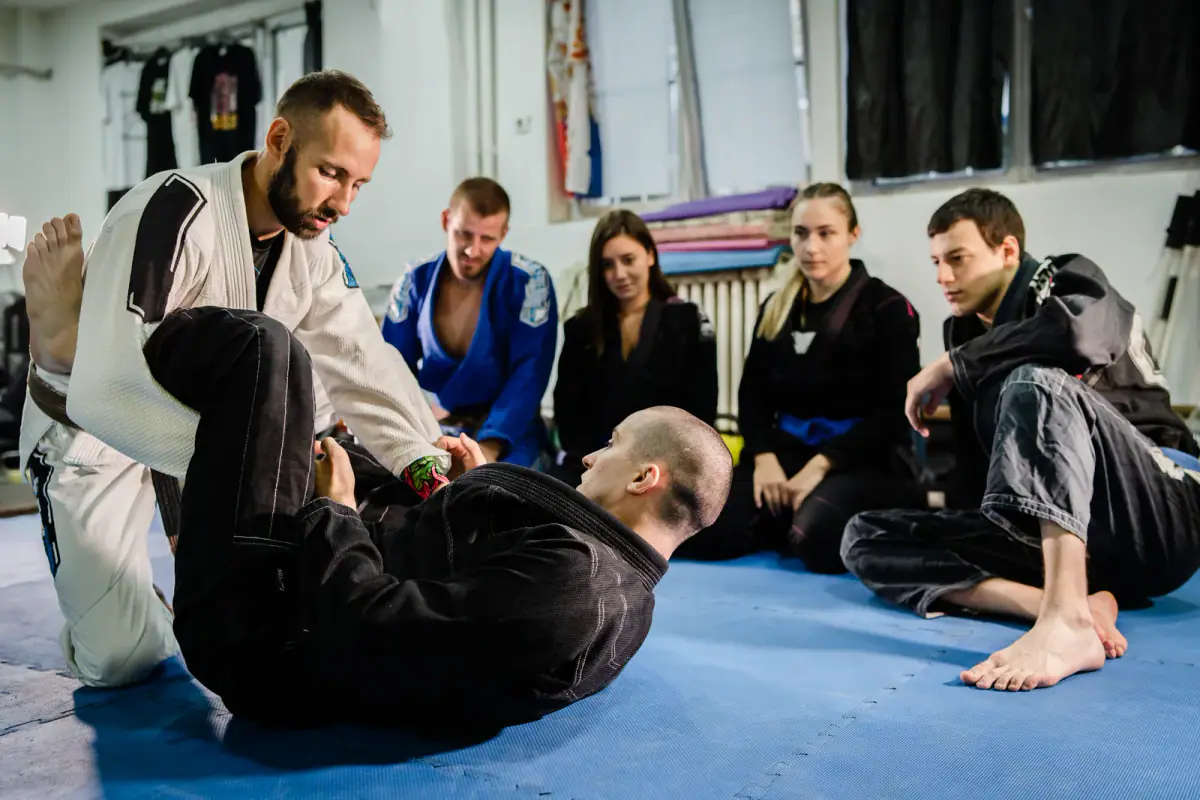
A hard-floor private room can host jiu jitsu private lessons built on standing and positional drilling, but not ground rolling, and any plan that depends on a cushioned surface should be cleared with the facility first. If you are leaving or supplementing a school, this is the honest answer: you can build a useful private practice without a gym, but the curriculum has to match what the floor allows. To talk through your lesson plan with the team, bring the specifics below.
What the floor decides
Grappling asks two things of a surface: grip for the feet and forgiveness for the body. A hard commercial floor gives the first and not the second. Falls, sprawls and scrambles that a school’s grappling surface absorbs would hit a firm floor at full force, and that is a risk for the student and a liability question for you.
So before you write a lesson, split your syllabus in two:
- Floor-light skills: grip fighting, posture, stance, hand placement, entries that stop short of a throw, hip movement drills and positional walkthroughs done standing or kneeling.
- Floor-heavy skills: takedowns completed, ground transitions at speed, live rolling and anything that ends in someone landing.
A private room is a good home for the first list. The second list belongs on a purpose-built grappling surface, however you arrange access to one.
What a private hour can still deliver
A well-planned private jiu jitsu hour without ground work is not a watered-down lesson. It is the part of the sport that most students under-practice. A sample hour:
- Ten minutes of mobility for hips, neck and shoulders.
- Twenty minutes of grip and posture drilling against a standing partner, at slow speed.
- Fifteen minutes of positional talk-throughs, with you demonstrating and the student repeating the movement standing.
- Ten minutes of strength work with the room’s rack, cables or dumbbells, aimed at pulling, carrying and trunk strength.
- Five minutes of video review on the room’s TV, since the space is built to be filming-friendly.
Students who compete often value that conditioning and video review more than another rolling round, and it suits a one-on-one setting where you can correct detail. For a wider look at what instructors run in a private room, the martial arts instructor space overview covers the standing arts side.
Bringing equipment: what to ask first
Instructors often carry training aids in a bag: grip tools, bands, a training dummy for some drills, belts for a test. Facilities that rent by the hour commonly allow carry-in gear that goes out with you, but larger items, anything heavy and anything meant for the floor raise policy questions only the facility can answer. The general etiquette is laid out in bringing your own equipment to a rented space.
Do not assume. Write to the pro support team at prosupport@flexwerkfitness.com, or ask through the app, and ask three exact questions:
- Which items may I bring in, and which not?
- May a student and I use any floor protection I carry in, and are there size or weight limits?
- Is there a rule on contact work or partner drilling in the rooms?
Save the reply with your booking notes. If the answer to the second question is no, your plan is the standing curriculum above and nothing is lost.
Planning around the limits
Many instructors in your position blend two settings: a private room for standing, conditioning and review lessons, and a school or partner facility for live training. The private room carries the one-on-one income, and the other setting carries the ground work. If you teach students who also hold a belt rank, a small promotion event has its own rules, covered in holding a belt test in rented space.
Spaces rent by the hour with no lease, you keep what you charge, and the first hour is free for fitness professionals. Use that hour to run your standing curriculum with one student and see whether the format feels like a lesson worth selling, then ask the support team about anything floor-related before you book more.
Related questions
Can I run live rolling in a rented private room?
Treat it as a question for the facility, not an assumption. Rolling puts two people on the floor with falls and scrambles, and a hard surface changes the risk. Ask the pro support team in writing before you plan a lesson around it.
What can I teach with no grappling floor at all?
Standing positional work, grips and posture, entries without throws, movement drills, strength and mobility for grappling, and video review all run on a hard floor. Plan the curriculum around those and keep the ground game for a proper surface.
Do I have to bring my own equipment?
Specialty items, such as training aids, are normally carried in and out by the instructor. Whether larger items can be brought in is a policy detail to confirm with the facility before you book.